
Joseph De Lamar
Values Codes I – E – L – P
Joseph De Lamar (1843-1918) was born in Amsterdam.
His father, of Moroccan descent, died in 1847, leaving a widow and eight children, including four-year-old Joseph.
Along the Way . . .
At a young age, Joseph stowed away on a Dutch trading vessel headed to the Caribbean and America.
He worked on ships until, at twenty-three, he became a ship’s captain and sailed around the world for several years, including a journey up the Gambia River in West Africa.
De Lamar returned to America in 1878, learned of the discovery of mineral wealth in the western U.S., and headed to Colorado.
He bought a lead mine and sold it for a large profit.
Idaho
De Lamar then moved to Idaho and purchased a mountain that proved to have large veins of gold and silver.
He extracted $1.5 million in minerals and sold a half interest in the remaining stake for $2 million.
Congress admitted Idaho to statehood in 1890 and inaugural elections for the state legislature occurred later that year.
Joseph De Lamar won election to the Idaho senate for a two-year term.
New York
At the end of his term, he declined a U.S. Senate seat representing Idaho.
Instead, he headed to New York City for the rest of his life.
De Lamar aspired to join New York’s wealthiest elite; he owned two yachts and belonged to three yacht clubs.
In 1902, he built a Parisian-style mansion at the corner of Manhattan’s Madison Avenue and 37th Street.
De Lamar then built an even larger mansion on a forty-seven acre country estate on Long Island’s exclusive north shore.
The house contained fifty rooms, sixty thousand square feet of living space, and stained-glass windows designed by famed glass artist Louis Comfort Tiffany.
Joseph De Lamar died in 1918, leaving an estate exceeding $29 million.
He made five-million-dollar bequests to Columbia, Harvard, and Johns Hopkins Universities to support their public health education programs.
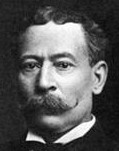
Joseph De Lamar
Source
- Mark Rutzik, Breaking New Ground: The Untold Story of Early America’s Jewish Electoral Pioneers – 1788 to 1920, 2025.
Mark Rutzick is the curator of this Joseph De Lamar exhibit.